Community Participation in #AWP26 Conference & Bookfair

The following report compiles demographics for presenters of proposed and accepted events in the 2026 AWP Conference & Bookfair.
 

Consistent with data we have made public in recent years, we offer insights into the self-reported race/ethnicity, gender, sexual orientation, disability status, and age of presenters included in 2026 event proposals. AWP uses responses in the aggregate only (in general sums and percentages) for reports to our funders and members. AWP never discloses individual characteristics or identifying information in such reports, nor does AWP share individual characteristics with the subcommittee members who evaluate proposals.
 

Visit the How Events Are Selected page for details about how the 2026 AWP Subcommittee made their selections. AWP is grateful to the subcommittee for their hard work in assembling a balanced and inclusive schedule for the 2026 conference.
 

Thank you to all who took the time to provide the information presented in this report. Your participation is critical to ensuring the AWP Conference and Bookfair represents our literary community year after year. Over the next few months, we expect the distributions presented below to change slightly as some panelists step off events, either because they are committed to more than two accepted events or for other reasons, and other panelists take their place. Event organizers will select replacements. AWP limits the number of events in which any one presenter may participate to increase participation in and inclusivity of the conference.


Table Of Contents


The following headings are page navigation links. Please click the section you would like to view.


A Note on System Transition

2026 Presenters Who Identified Themselves by Race or Ethnicity

2026 Not-Accepted vs. Accepted Participants by Race or Ethnicity

2026 Presenters by Race or Ethnicity, Compared to 2023–2025

2026 Presenters Who Identify Themselves by Gender

2026 Not-Accepted vs. Accepted Participants by Gender

2026 Presenters by Gender, Compared to 2023–2025

2026 Presenters Who Identified Themselves by Sexual Orientation

2026 Not-Accepted vs. Accepted Participants by Sexual Orientation

2026 Presenters by Sexual Orientation, Compared to 2023–2025

2026 Presenters Who Identified Themselves by Disability

2026 Not-Accepted vs. Accepted Participants by Disability

2026 Presenters by Disability Status, Compared to 2023–2025

2026 Presenters Who Identified Themselves by Age

2026 Not-Accepted vs. Accepted Participants by Age

2026 Presenters by Age, Compared to 2023–2025


A Note on System Transition


AWP transitioned web software systems and its database recently, and as part of this transition, response options to demographic questions have been updated. Comparisons between this year’s data and that from previous years will therefore be approximate.
 

The transition has also impacted response rates for the 2026 cycle, as users needed to access these new systems for the first time, reset their passwords, and update demographic information. In most cases, 2026 response rates remain statistically significant and representative. We anticipate response rates in future conference cycles to increase as users adapt to the new system.


[Community Data Report continues below]


2026 Presenters Who Identified Themselves by Race or Ethnicity*
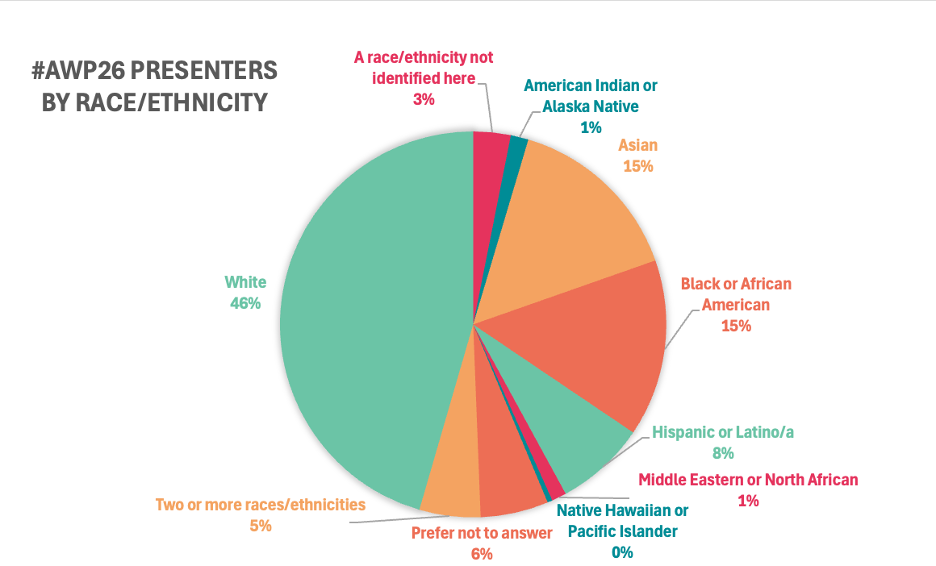
Above: A pie chart with ten alternating green, yellow, orange, red, and turquoise sections. The chart presents the breakdown of presenters who self-identified by race or ethnicity. Clockwise from top: 3% identified as a race/ethnicity not offered, 1% as American Indian or Alaska Native, 15% as Asian, 15% as Black or African American, 8% as Hispanic or Latino/a, 1% as Middle Eastern or North African, 0% as Native Hawaiian or Pacific Islander, 5% as mixed race, and 46% as white. 6% chose not to answer. Below: A table with green borders that displays counts of presenters who identified themselves by race/ethnicity. The table shows that 38 presenters identify as a race/ethnicity not offered, 18 identify as American Indian or Alaska Native, 182 as Asian, 180 as Black or African American, 92 as Hispanic or Latino/a, 15 as Middle Eastern or North African, 5 as Native Hawaiian or Pacific Islander, 62 as mixed race, and 552 as white. 69 chose not to answer.

Race/Ethnicity

# of Presenters

A race/ethnicity not identified here

38

American Indian or Alaska Native

18

Asian

182

Black or African American

180

Hispanic or Latino/a

92

Middle Eastern or North African

15

Native Hawaiian or Pacific Islander

5

Prefer not to answer

69

Two or more races/ethnicities

62

White

552

Grand Total

1213


* Statistics reflect an 82.3% response rate. Of 1,474 presenters, 1,213 responded to the race/ethnicity demographics question. Presenters that self-identified as a race/ethnicity not included in the survey or selected “prefer not to answer” were figured as respondents.


2026 Not-Accepted vs. Accepted Participants by Race or Ethnicity*
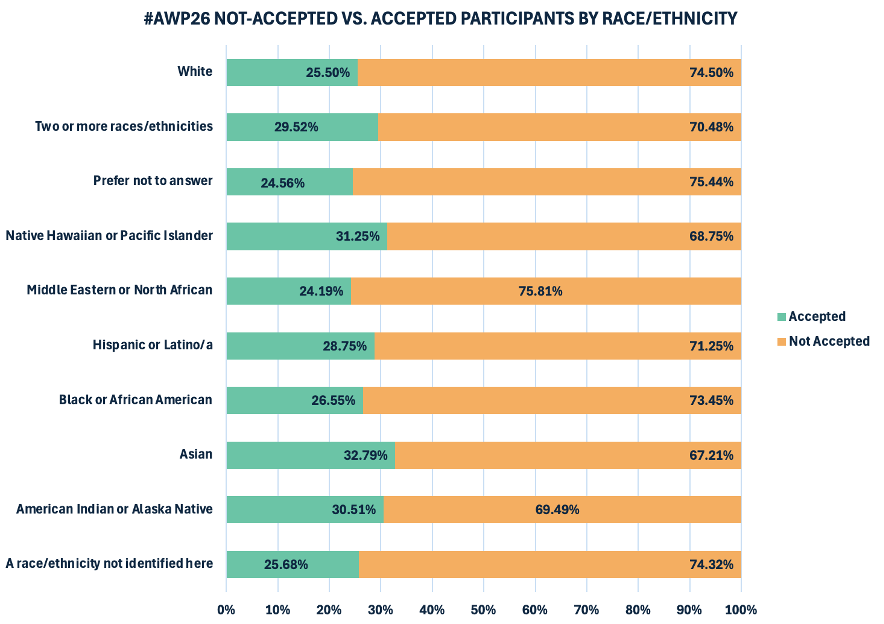
A horizontal stacked bar graph with race/ethnicity on the y-axis and percentages of accepted (green) and not-accepted (yellow) participants on the x-axis. Percentages are out of 100%. The graph shows the following counts (from bottom to top). Of participants who identify as a race/ethnicity not specified, 25.68% were accepted and 74.32% were not accepted. Of participants who identify as American Indian or Alaska Native, 30.51% were accepted and 69.49% were not. Of participants who identify as Asian, 32.79% were accepted and 67.21% were not. Of participants who identify as Black or African American, 26.55% were accepted and 73.45% were not. Of participants who identify as Hispanic or Latino/a, 28.75% were accepted and 71.25% were not. Of participants who identify as Middle Eastern or North African, 24.19% were accepted and 75.81% were not. Of participants who identify as Native Hawaiian or Pacific Islander, 31.25% were accepted and 68.75% were not. Of participants who identify as mixed race, 29.52% were accepted and 70.48% were not. Of participants who identify as white: 25.50% were accepted and 74.50% were not. Of participants who chose not to answer, 24.56% were accepted and 75.44% were not.


* Statistics reflect an 82.3% response rate for accepted participants (1,213 respondents out of 1,474 accepted participants) and a 78.5% response rate for not-accepted participants (3,281 respondents out of 4,176 not-accepted participants). Participants that self-identified as a race/ethnicity not included in the survey or selected “prefer not to answer” were figured as respondents.


2026 Presenters by Race or Ethnicity, Compared to 2023–2025*
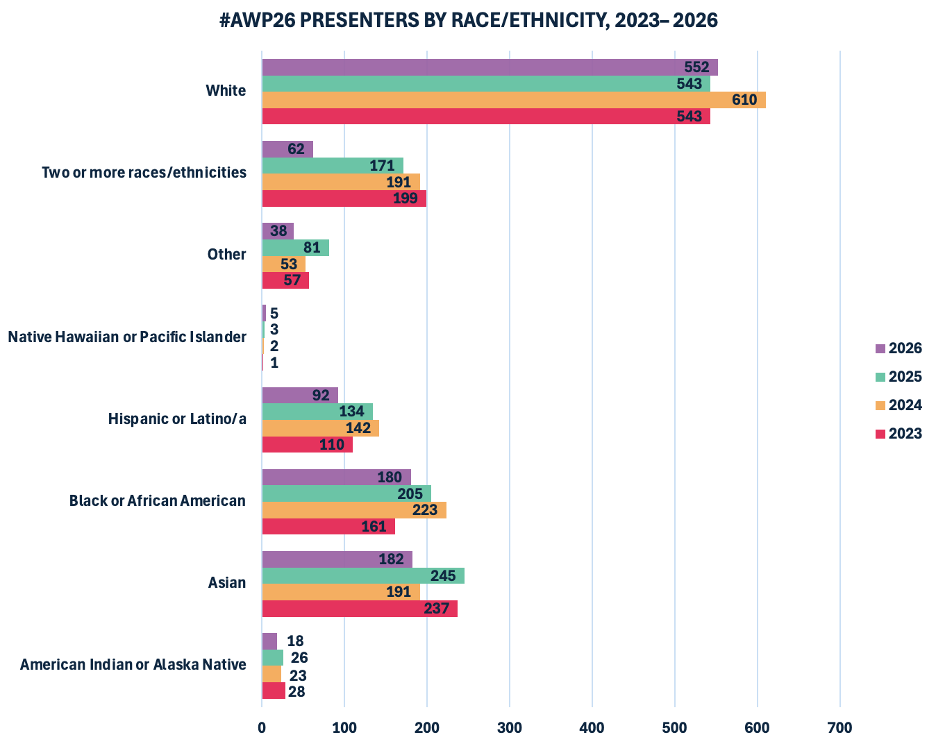
A stacked bar graph with race/ethnicity on the y-axis and presenter counts on the x-axis; each race/ethnicity category has four horizontal bars in purple, green, yellow, and red, corresponding to data from AWP conferences in 2023 through 2026. The graph shows the following counts (from bottom to top). Presenters who identify as American Indian or Alaska Native: 18 in 2026, 26 in 2025, 23 in 2024, and 28 in 2023. Presenters who identify as Asian: 182 in 2026, 245 in 2025, 191 in 2024, and 237 in 2023. Presenters who identify as Black or African American: 180 in 2026, 205 in 2025, 223 in 2024, and 161 in 2023. Presenters who identify as Hispanic or Latino/a: 92 in 2026, 134 in 2025, 142 in 2024, and 110 in 2023. Presenters who identify as Native Hawaiian or Pacific Islander: 5 in 2026, 3 in 2025, 2 in 2024, and 1 in 2023. Presenters who identify as another race not specified: 38 in 2026, 81 in 2025, 53 in 2024, and 57 in 2023. Presenters who identify as mixed race: 62 in 2026, 171 in 2025, 191 in 2024, and 199 in 2023. Presenters who identify as white: 552 in 2026, 543 in 2025, 610 in 2024,


* Statistics reflect the following response rates:

82.3% response rate in 2026. See “A Note on System Transitionfor more information regarding the 2026 response rate.

91.6% response rate in 2025

92.7% response rate in 2024

90.7% response rate in 2023


2026 Presenters Who Identify Themselves by Gender*
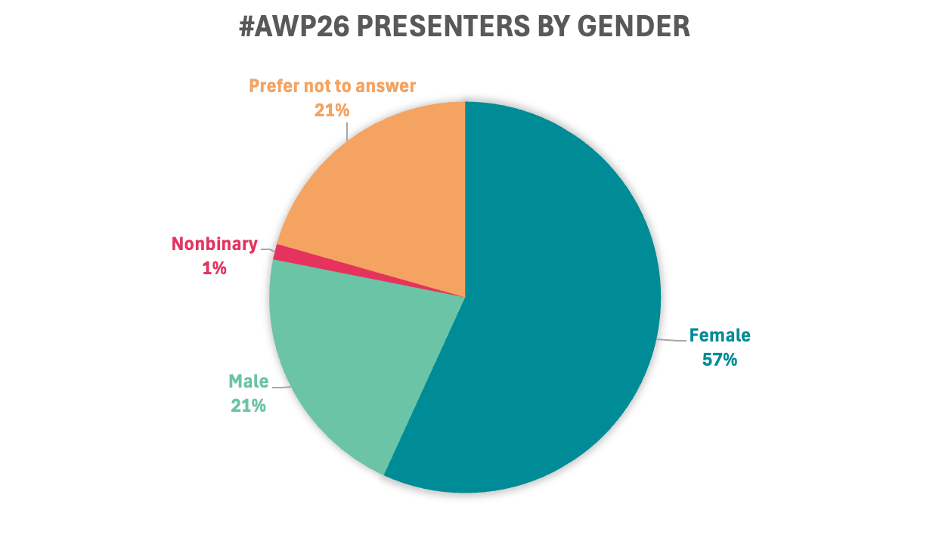
https://conference.awpwriter.org/documents/2026_Presenters_Who_Identify_Themselves_by_Gender.png

Gender

# of Presenters

Female

662

Male

248

Nonbinary**

15

Prefer not to answer

240

Grand Total

1165


* Statistics reflect a 79.1% response rate. Of 1,474 presenters, 1,165 responded to the gender demographics question. Presenters that selected “prefer not to answer” were figured as respondents.


2026 Not-Accepted vs. Accepted Participants by Gender*
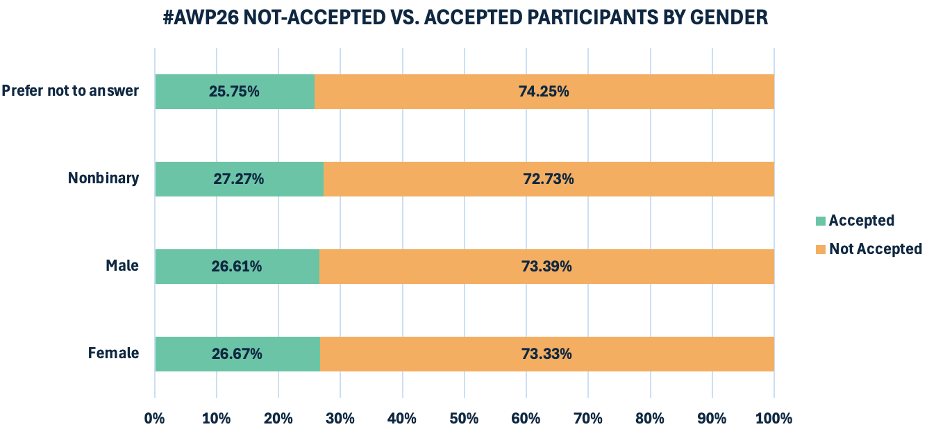
A horizontal stacked bar graph with gender on the y-axis and percentages of accepted (green) and not-accepted (yellow) participants on the x-axis. Percentages are out of 100%. The graph shows the following counts (from bottom to top). Of participants who identify as female, 26.67% were accepted and 73.33% were not. Of participants who identify as male, 26.61% were accepted and 73.39% were not. Of participants who identify as nonbinary, 27.27% were accepted and 72.73% were not. Of participants who chose not to answer, 25.75% were accepted and 74.25% were not.
 

* Statistics reflect a 79.1% response rate for accepted participants (1,165 respondents out of 1,474 accepted participants) and a 77.5% response rate for not-accepted participants (3,236 respondents out of 4,176 not-accepted participants). Participants who selected “prefer not to answer” were figured as respondents.


2026 Presenters by Gender, Compared to 2023–2025*
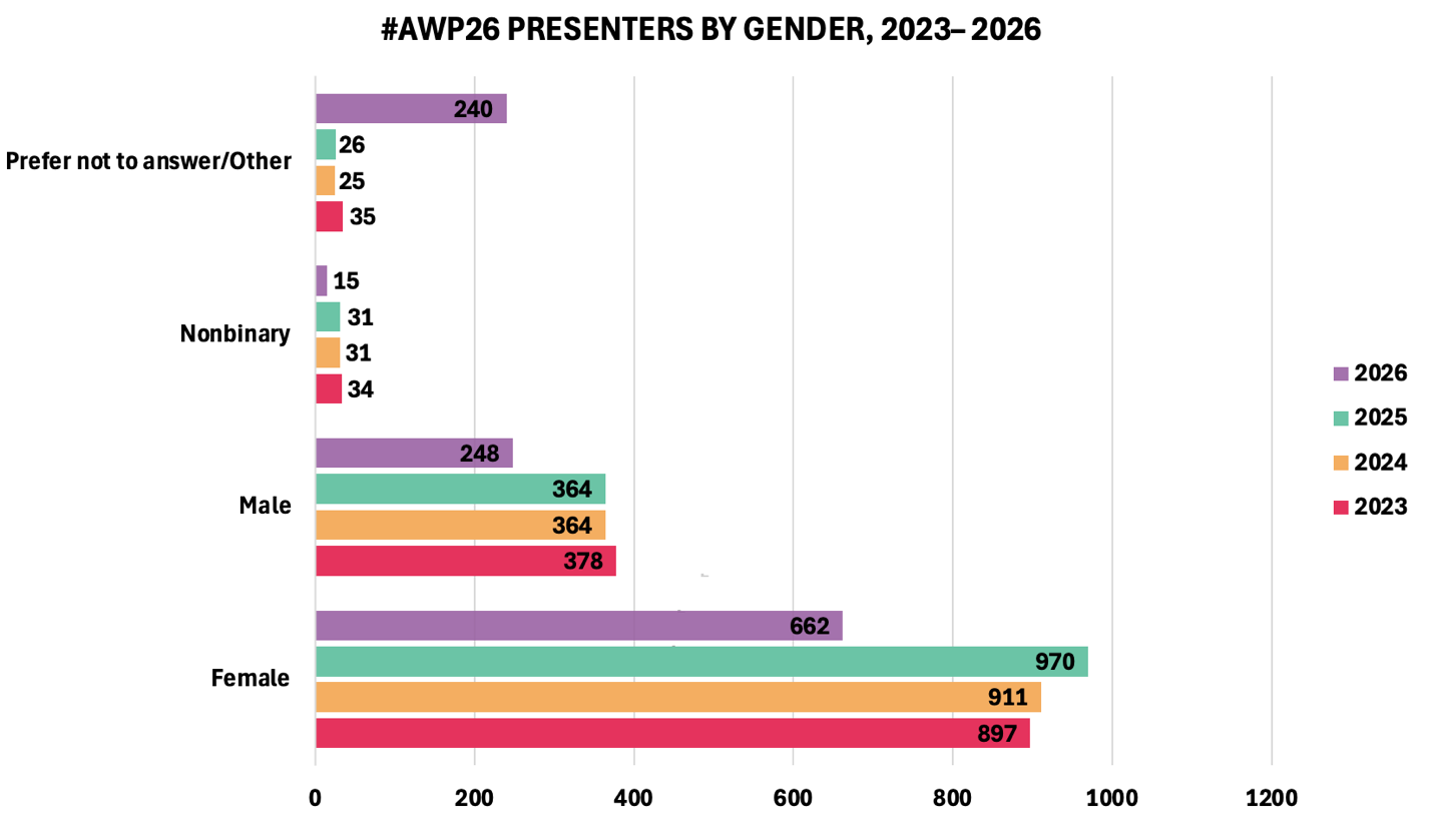
A stacked bar graph with gender on the y-axis and presenter counts on the x-axis; each gender category has four horizontal bars in purple, green, yellow, and red, corresponding to data from AWP conferences in 2023 through 2026. The graph shows the following counts (from bottom to top). Presenters who identify as female: 662 in 2026, 970 in 2025, 911 in 2024, and 897 in 2023. Presenters who identify as male: 248 in 2026, 364 in 2025, 364 in 2024, and 378 in 2023. Presenters who identify as nonbinary: 15 in 2026, 31 in 2025, 31 in 2024, and 34 in 2023. Presenters who identify as another gender (multiple categories offered 2023–2025) or chose not to answer (2026 only): 240 in 2026, 26 in 2025, 25 in 2024, and 35 in 2023.
 

* Statistics reflect the following response rates:

79.1% response rate in 2026

98.4% response rate in 2025

95.8% response rate in 2024

95.0% response rate in 2023


2026 Presenters Who Identified Themselves by Sexual Orientation*
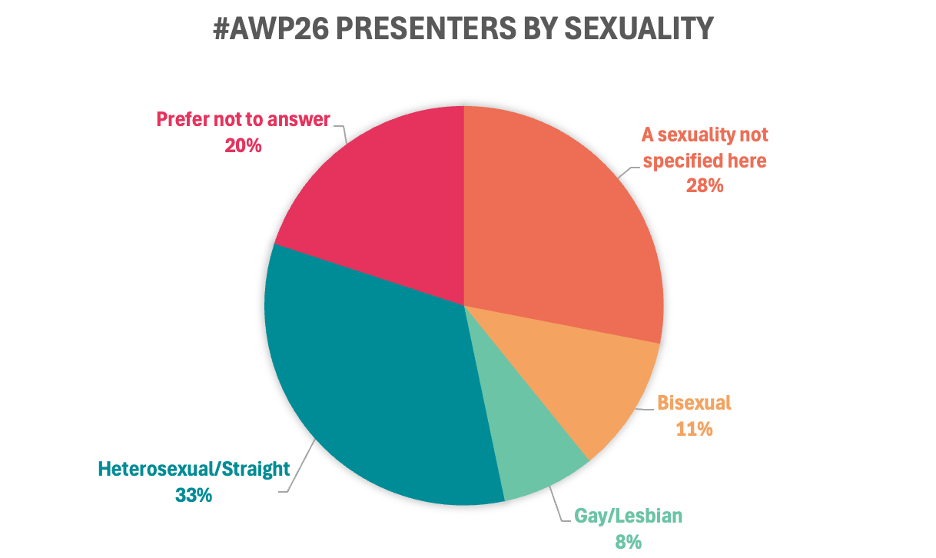
Above: A pie chart with five alternating green, yellow, red, orange, and turquoise sections. The chart presents the breakdown of presenters (accepted events only) who self-identified by sexuality. Clockwise from right: 28% identify as a sexuality not specified, 11% as bisexual, 8% as gay/lesbian, and 33% as heterosexual/straight. 20% chose not to answer. Below: A table with green borders that displays counts of accepted presenters who identified themselves by sexual orientation. The table shows that 368 presenters identify as a sexuality not offered, 146 identify as bisexual, 99 as gay/lesbian, and 437 as heterosexual/straight. 262 chose not to answer.

Sexual Orientation

# of Presenters

A sexuality not specified here

368

Bisexual

146

Gay/Lesbian

99

Heterosexual/Straight

437

Prefer not to answer

262

Grand Total

1312


* Statistics reflect an 89.0% response rate. Of 1,474 presenters, 1,312 responded to the sexuality demographics question. Presenters that selected “prefer not to answer” were figured as respondents.


2026 Not-Accepted vs. Accepted Participants by Sexual Orientation*
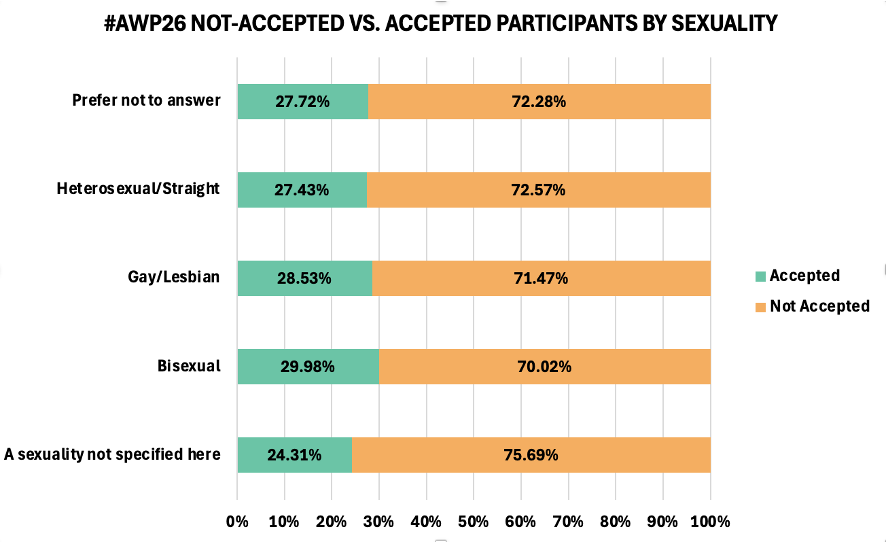
A horizontal stacked bar graph with sexual orientation on the y-axis and percentages of accepted (green) and not-accepted (yellow) participants on the x-axis. Percentages are out of 100%. The graph shows the following counts (from bottom to top). Of participants who identify as heterosexual, 27.43% were accepted and 72.57% were not. Of participants who identify as gay or lesbian, 28.53% were accepted and 71.47% were not. Of participants who identify as bisexual, 28.98% were accepted and 79.02% were not. Of participants who identify as a sexuality not specified, 24.31% were accepted and 75.69% were not. Of participants who chose not to answer, 27.72% were accepted and 72.28% were not.
 

* Statistics reflect an 89.0% response rate for accepted participants (1,312 respondents out of 1,474 accepted participants) and an 85.6% response rate for not-accepted participants (3,574 respondents out of 4,176 not-accepted participants). Participants who selected “prefer not to answer” were figured as respondents.


2026 Presenters by Sexual Orientation, Compared to 2023–2025*
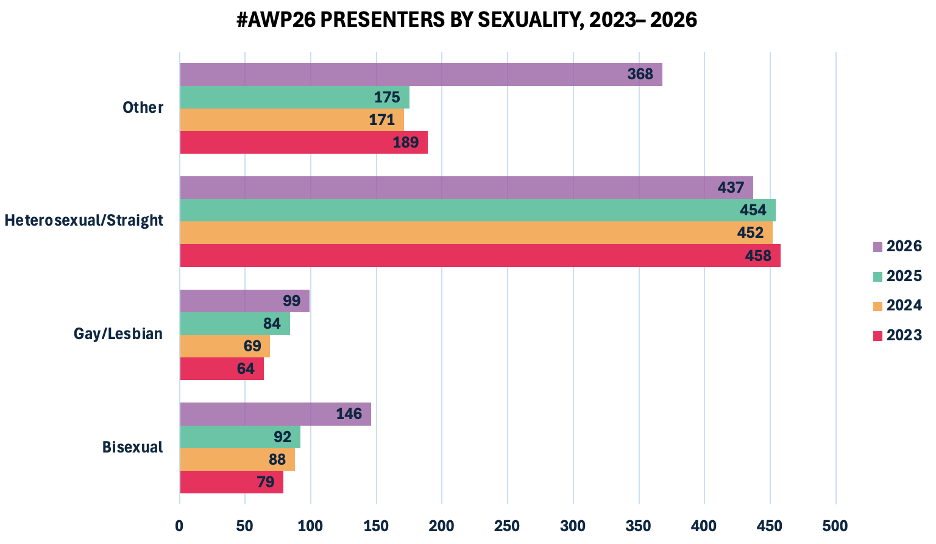
A stacked bar graph with sexual orientation on the y-axis and presenter counts on the x-axis; each sexual orientation category has four horizontal bars in purple, green, yellow, and red, corresponding to data from AWP conferences in 2023 through 2026. The graph shows the following counts (from bottom to top). Presenters who identify as bisexual: 146 in 2026, 92 in 2025, 88 in 2024, and 79 in 2023. Presenters who identify as gay or lesbian: 99 in 2026, 84 in 2025, 69 in 2024, and 64 in 2023. Presenters who identify as heterosexual: 437 in 2026, 454 in 2025, 452 in 2024, and 458 in 2023. Presenters who identify as another sexuality not specified here: 368 in 2026, 175 in 2025, 171 in 2024, and 189 in 2023.


* Statistics reflect the following response rates:

79.1% response rate in 2026

58.9% response rate in 2025

58.9% response rate in 2024

57.6% response rate in 2023


2026 Presenters Who Identified Themselves by Disability*
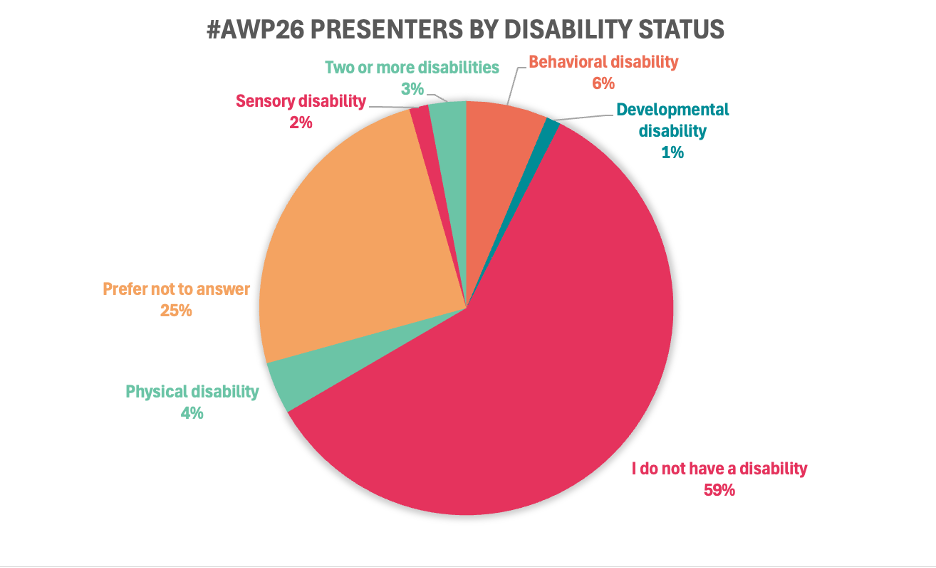
Above: A pie chart with seven alternating green, yellow, red, orange, and turquoise sections. The chart presents the breakdown of presenters (accepted events only) who self-identified by disability status. Clockwise from top: 2% identify as having a sensory disability, 4% as having two or more disabilities, 6% as having a behavioral disability, 1% as having a developmental disability, 58% as not having a disability, and 4% as having a physical disability. 25% chose not to answer. Below: A table with green borders that displays counts of presenters who identified themselves by disability status. The table shows that 73 presenters identify as having a behavioral disability, 13 as having a developmental disability, 678 as not having a disability, 47 as having a physical disability, 17 as having a sensory disability, and 34 as having multiple disabilities. 285 chose not to answer.

Disability

# of Presenters

Behavioral disability

73

Developmental disability

13

I do not have a disability

678

Physical disability

47

Prefer not to answer

285

Sensory disability

17

Two or more disabilities

34

Grand Total

1147


* Statistics reflect a 77.8% response rate. Of 1,474 presenters, 1,147 responded to the disability demographics question. Presenters that selected “prefer not to answer” were figured as respondents.


2026 Not-Accepted vs. Accepted Participants by Disability*
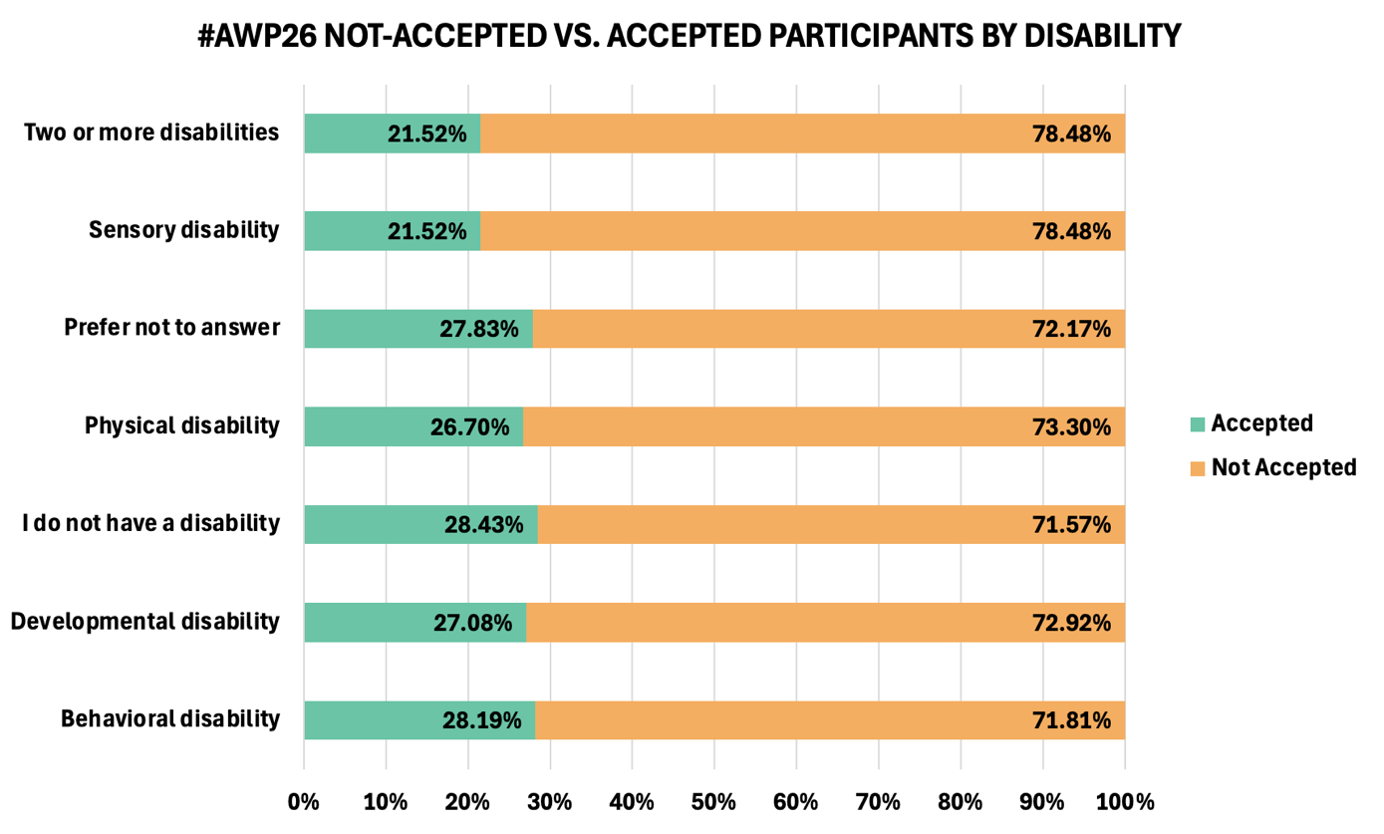
A horizontal stacked bar graph with disability on the y-axis and percentages of accepted (green) and not-accepted (yellow) participants on the x-axis. Percentages are out of 100%. The graph shows the following counts (from bottom to top). Of participants who identify as having a behavioral disability, 28.18% were accepted and 71.81% were not. Of participants who identify as having a developmental disability, 27.08% were accepted and 72.92% were not. Of participants who do not identify as having a disability, 28.43% were accepted and 71.57% were not. Of participants who identify as having a physical disability, 26.70% were accepted and 73.30% were not. Of participants who identify as having a sensory disability, 21.52% were accepted and 78.48% were not. Of participants who identify as having multiple disabilities, 21.52% were accepted and 78.48% were not. Of participants who chose not to answer, 27.83% were accepted and 72.17% were not.

* Statistics reflect a 77.8% response rate for accepted participants (1,147 respondents out of 1,474 accepted participants) and a 71.4% response rate for not-accepted participants (2,982 respondents out of 4,176 not-accepted participants). Participants who selected “prefer not to answer” were figured as respondents.


2026 Presenters by Disability Status, Compared to 2023–2025*
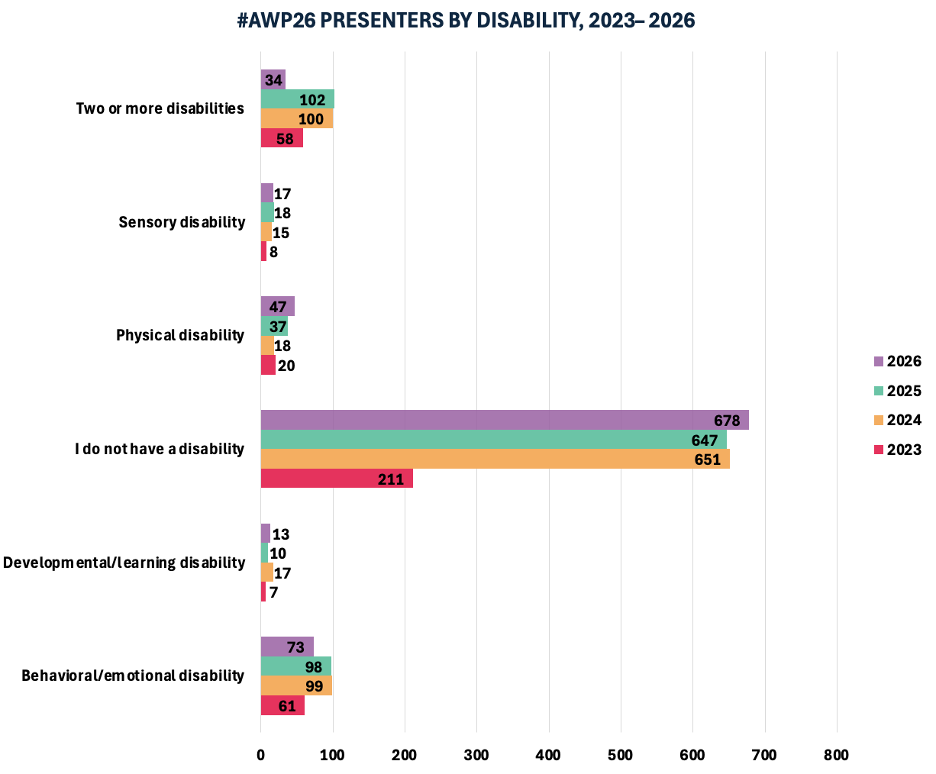
A stacked bar graph with disability status on the y-axis and presenter counts on the x-axis; each disability category has four horizontal bars in purple, green, yellow, and red, corresponding to data from AWP conferences in 2023 through 2026. The graph shows the following counts (from top to bottom). Presenters who identify as having two or more disabilities: 24 in 2026, 102 in 2025, 100 in 2024, and 58 in 2023. Presenters who identify as having a sensory disability: 17 in 2026, 18 in 2025, 15 in 2024, and 8 in 2023. Presenters who identify as having a physical disability: 47 in 2026, 37 in 2025, 18 in 2024, and 20 in 2023. Presenters who identify as having a developmental or learning disability: 13 in 2026, 10 in 2025, 17 in 2024, and 7 in 2023. Presenters who identify as having a behavioral or emotional disability: 73 in 2026, 98 in 2025, 99 in 2024, and 61 in 2023. Presenters who report not having a disability of any type: 678 in 2026, 647 in 2025, 651 in 2024, and 211 in 2023.
 

* Statistics reflect the following response rates:

77.8% response rate in 2026

58.1% response rate in 2025

60.5% response rate in 2024

26.5% response rate in 2023


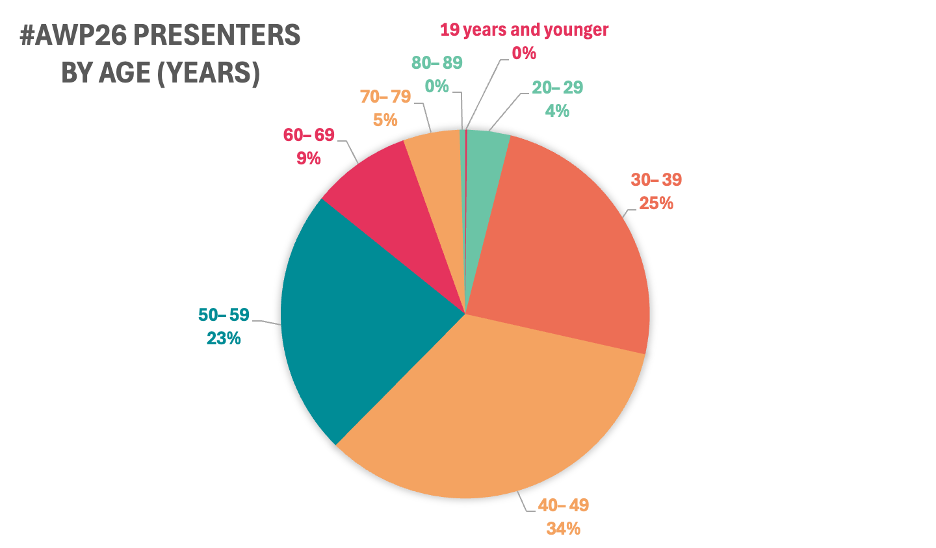
2026 Presenters Who Identified Themselves by Age*
https://conference.awpwriter.org/documents/2026_Presenters_Who_Identified_Themselves_by_Age.png

Age

# of Presenters

19 years and younger

2

20–29 years

46

30–39 years

297

40–49 years

410

50–59 years

283

60–69 years

106

70–79 years

60

80–89 years

6

Grand Total

1210


* Statistics reflect an 82.1% response rate. Of 1,474 presenters, 1,210 responded to the age demographics question.


2026 Not-Accepted vs. Accepted Participants by Age*
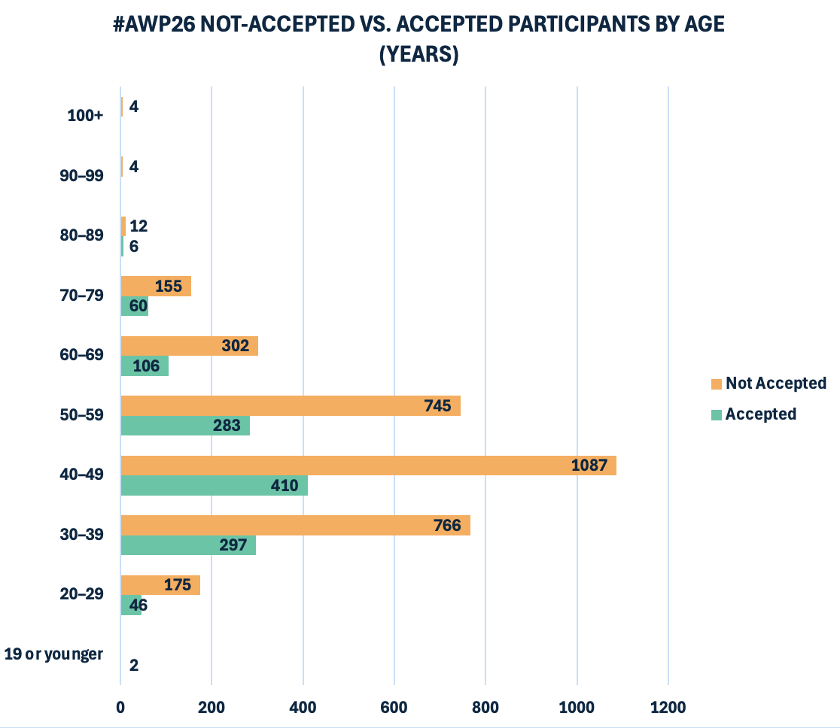
A stacked bar graph with age (in years) on the y-axis and presenter counts on the x-axis; each age category has two horizontal bars in green and yellow, corresponding to counts of participants on accepted and not-accepted proposals. The graph shows the following counts (from bottom to top). Of participants 19 or younger, 2 were accepted and 0 were not. Of participants between 20 and 29, 46 were accepted and 175 were not. Of participants between 30 and 39, 297 were accepted and 766 were not. Of participants between 40 and 49, 410 were accepted and 1,087 were not. Of participants between 50 and 59, 283 were accepted and 745 were not. Of participants between 60 and 69, 106 were accepted and 302 were not. Of participants between 70 and 79, 60 were accepted and 155 were not. Of participants between 80 and 89, 6 were accepted and 12 were not. Of participants 90 and older, 0 were accepted and 8 were not.
 

* Statistics reflect an 82.1% response rate for accepted participants (1,210 respondents out of 1,474 accepted participants) and a 77.8% response rate for not-accepted participants (3,250 respondents out of 4,176 not-accepted participants).


2026 Presenters by Age, Compared to 2023–2025*
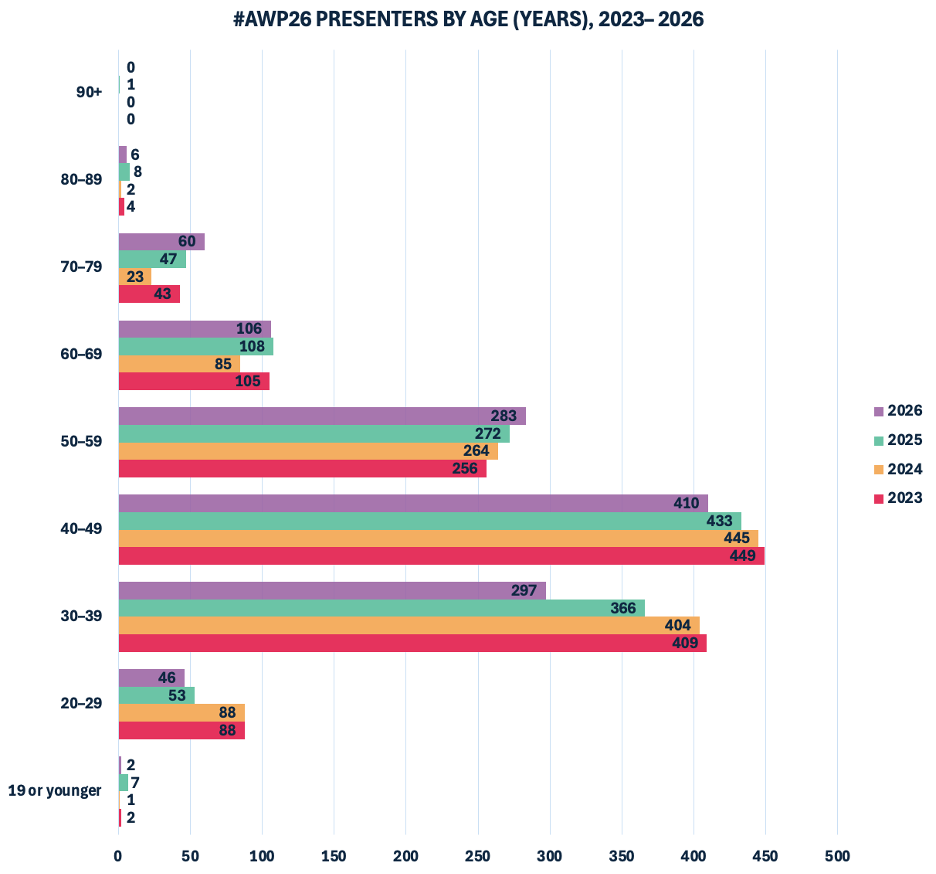
A stacked bar graph with age on the y-axis and presenter counts on the x-axis; each age category has four horizontal bars in purple, green, yellow, and red, corresponding to data from AWP conferences in 2023 through 2026. The graph shows the following counts (from bottom to top). Presenters 19 years or younger: 2 in 2026, 7 in 2025, 1 in 2024, and 2 in 2023. Presenters 20–29 years: 46 in 2026, 53 in 2025, 88 in 2024, and 88 in 2023. Presenters 30–39: 297 in 2026, 366 in 2025, 404 in 2024, and 409 in 2023. Presenters 40–49: 410 in 2026, 433 in 2025, 445 in 2024, and 449 in 2023. Presenters 50–59: 283 in 2026, 272 in 2025, 264 in 2024, and 256 in 2023. Presenters 60–69: 106 in 2026, 108 in 2025, 85 in 2024, and 105 in 2023. Presenters 70–79: 60 in 2026, 47 in 2025, 23 in 2024, and 43 in 2023. Presenters 80–89: 6 in 2026, 8 in 2025, 2 in 2024, and 4 in 2023. In 2025 only there was one presenter 90 years or older.
 

* Statistics reflect the following response rates:

82.1% response rate in 2026

81.8% response rate in 2025

83.5% response rate in 2024

86.0% response rate in 2023